
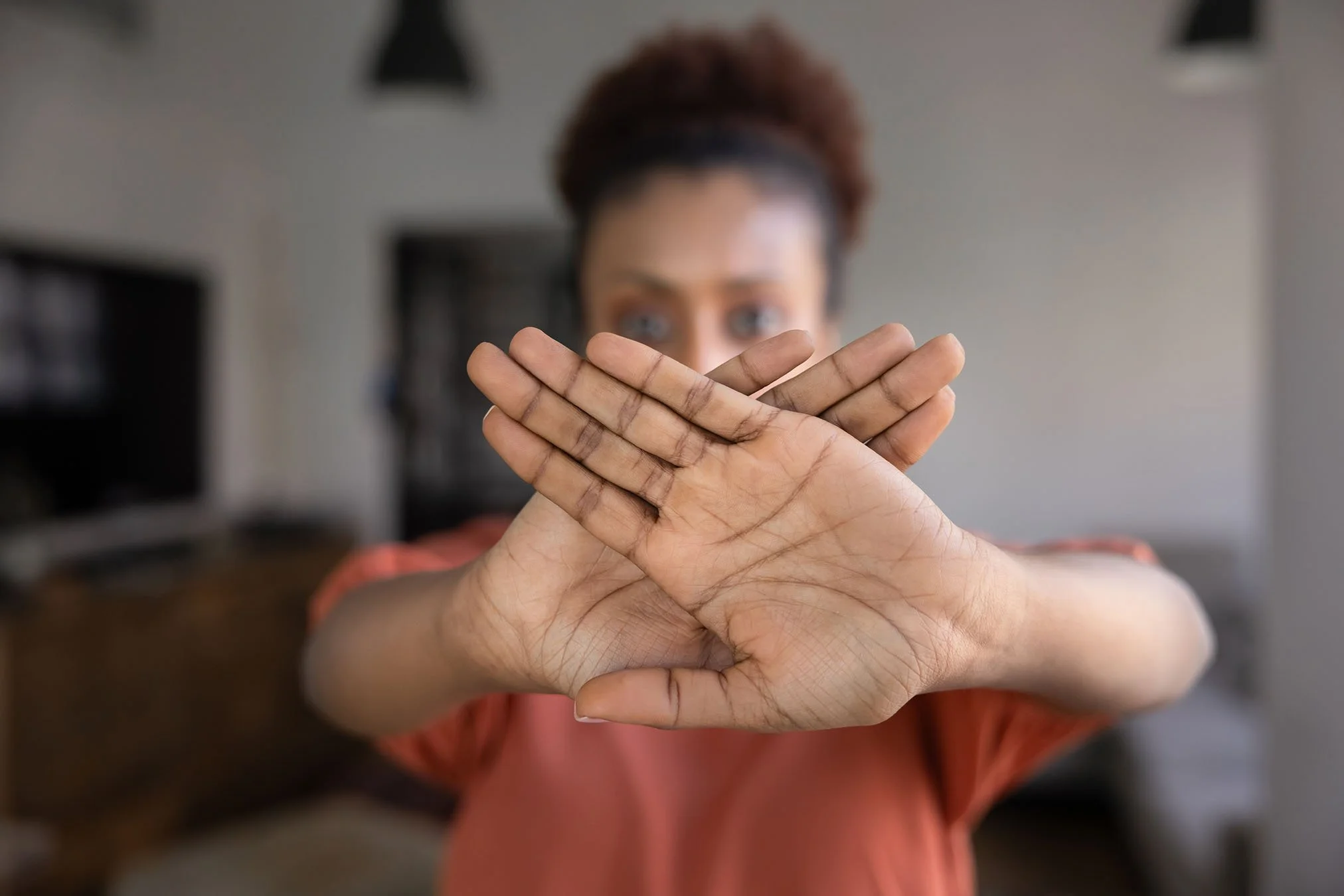
For many survivors of domestic and sexual violence, the word “no” can feel complicated—even unsafe. It may carry echoes of past experiences where boundaries were ignored, punished, or manipulated. At Steps to Hope, we often hear from individuals who struggle not with understanding what they need—but with giving themselves permission to say it out loud.
Yet, learning to say “no” is one of the most powerful and transformative forms of self-care. It is not rejection. It is not selfishness. It is not cruelty. It is a declaration: I matter. My needs matter. My safety matters.
This blog explores how boundaries help reclaim control, why guilt often shows up in the process, and how simple boundary-setting scripts can help you begin.
Why Boundaries Matter—Especially After Trauma
Survival often requires adaptation. For many survivors, that adaptation meant prioritizing someone else’s needs, minimizing conflict, or staying silent to stay safe. Over time, those patterns can become deeply ingrained.
When you begin healing, those same survival strategies may no longer serve you.
Boundaries are the bridge between survival and self-trust.
At Steps to Hope, we emphasize that boundaries are not about controlling others—they’re about defining what is and isn’t acceptable in your life. They help you:
Protect your emotional and physical well-being
Rebuild trust in your own instincts
Create space for healthy, respectful relationships
Regain a sense of control that may have been taken from you
Boundaries are not walls. They are doors—with locks that you control.
Why Saying “No” Feels So Hard
If saying “no” feels uncomfortable—or even terrifying—you’re not alone. There are real reasons behind that reaction:
1. Fear of Conflict
You may have learned that disagreement leads to escalation, punishment, or danger.
2. Guilt and Conditioning
Many survivors were conditioned to believe that their worth comes from being agreeable, helpful, or accommodating.
3. Loss of Identity
When your needs have been consistently overlooked, it can be difficult to even recognize what your boundaries are.
4. Trauma Responses
The “fawn” response—people-pleasing to stay safe—is a common trauma response that makes saying “no” feel risky.
At Steps to Hope, we remind survivors: if saying “no” feels hard, it’s not because you’re weak—it’s because you adapted to survive.
Reframing “No” as Self-Care
Self-care is often misunderstood as something soft or indulgent—bubble baths, candles, quiet time. While those things can be meaningful, real self-care is often much more courageous.
Sometimes, self-care sounds like:
“I’m not comfortable with that.”
“I can’t help with this right now.”
“I need space.”
“That doesn’t work for me.”
Saying “no” is an act of self-respect. It tells your mind and body that you are safe enough now to choose differently.
At Steps to Hope, we encourage survivors to view boundaries not as rejection—but as protection. You are not shutting people out. You are letting yourself in.
Boundary-Setting Scripts You Can Use
One of the biggest barriers to setting boundaries is simply not knowing what to say. When emotions are high, having a simple script can make all the difference.
Here are a few practical, adaptable scripts to help you get started:
For Declining Requests
“I’m not able to do that right now.”
“I appreciate you asking, but I have to say no.”
For Protecting Your Time
“I need to focus on my own priorities today.”
“I’m not available, but I hope it goes well.”
For Emotional Boundaries
“I’m not comfortable discussing that.”
“I need to step away from this conversation.”
For Repeated Boundary Violations
“I’ve already shared how I feel about this. I need that to be respected.”
“If this continues, I will need to remove myself.”
For Creating Space
“I need some time to think before I respond.”
“I’m taking some space right now to take care of myself.”
At Steps to Hope, we often suggest practicing these phrases out loud or writing them down. Your voice deserves to feel familiar to you again.
What About the Guilt?
Guilt is one of the most common—and most powerful—barriers to boundary-setting.
You might think:
“What if I’m being too harsh?”
“What if they’re upset with me?”
“What if I’m the problem?”
Here’s the truth: Guilt does not always mean you’re doing something wrong.
Sometimes, it means you’re doing something new.
When you’ve been conditioned to prioritize others, choosing yourself can feel uncomfortable at first. That discomfort is not a sign to stop—it’s a sign that you’re growing.
At Steps to Hope, we encourage survivors to pause and ask:
Is this guilt based on my values—or on old patterns?
Am I abandoning someone—or finally showing up for myself?
Would I expect someone I love to ignore their needs in this situation?
Over time, guilt often softens. In its place, something stronger begins to emerge: self-trust.
Reclaiming Control, One “No” at a Time
Healing is not about becoming someone new—it’s about returning to yourself.
Every time you say “no” to something that harms you, you are saying “yes” to something that supports you.
Yes to safety
Yes to clarity
Yes to rest
Yes to dignity
At Steps to Hope, we see this transformation every day. Survivors begin by setting small boundaries—declining a call, stepping away from a conversation, honoring their need for space. Over time, those small moments build into something powerful: a renewed sense of control.
You do not have to overhaul your life overnight. You can start with one boundary. One sentence. One moment of choosing yourself.
When Boundaries Feel Unsafe
It’s important to acknowledge that for some survivors, setting boundaries—especially with certain individuals—may still carry real risks.
If you are in a situation where saying “no” could lead to harm, your safety comes first.
At Steps to Hope, we offer support, advocacy, and resources to help individuals navigate these complex situations safely. You are not expected to do this alone.
You Are Allowed to Take Up Space
Saying “no” is not about pushing others away. It is about pulling yourself back into your own life.
You are allowed to:
Have limits
Change your mind
Prioritize your well-being
Protect your peace
And you are allowed to do all of that without apology.
At Steps to Hope, we believe that healing is not just about surviving what happened—it’s about building a life where your voice, your needs, and your boundaries are honored.
The next time you feel that hesitation rise in your chest, remember this:
“No” is not the end of something. It’s the beginning of something better.
